European Commission, EU Member States and 26 partner countries will launch a “Coalition of Trade Ministers for Climate”, the first global ministerial-level forum dedicated to trade, climate and sustainable development issues.
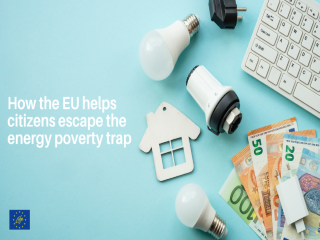
Energy poverty happens when individuals or households cannot adequately heat or cool their homes or avail of energy services at an affordable price. This can be due to high energy expenditure, low household incomes, and inefficient buildings and appliances. The global energy market disruption caused by Russia's invasion of Ukraine has worsened the situation.
Heating, cooling, lighting, and the energy to power appliances are vital for our health and standard of living. But an estimated 35 million EU households have reported being unable to keep their households warm.
Home renovations in rural areasThe LIFE CET RENOVERTY project team aims to encourage energy- and cost-efficient building upgrades in central, eastern and southern Europe. To do this, they will design 17 highly replicable renovation roadmaps in rural locations across Spain, Italy, Portugal, Hungary, Croatia, Estonia and Slovenia. The plan is to renovate more than 1 000 households, benefiting some 2 500 vulnerable consumers. The team will also ensure that building retrofits consider the social dimension to improve the quality of life of vulnerable populations.
Cutting the cost of energy renovations The LIFE CET EP-0 project aims to support the deep energy renovation of buildings in disadvantaged areas. They will employ the so-called 'EnergieSprong' approach, which retrofits homes with high energy-efficient standards. The team will test the approach in 10 vulnerable districts across Italy, France and the Netherlands. The goal is to decrease the cost of social housing renovations by embracing industrialised, prefabricated solutions.
Renovating homes and engaging householdsThe LIFE CET REVERTER project will develop nine roadmaps to identify the worst-performing houses and the most cost-effective renovation methods. This will help upgrade more homes on a specific budget, maximise energy and cost savings, and reduce greenhouse gas and pollutant emissions. Pilots in Bulgaria, Greece, Latvia and Portugal will result in large-scale replication under different building, climate and socioeconomic conditions. The team aims at facilitating the renovation of 800 houses and engaging people in the process through REVERTER ambassadors.
Making energy efficiency renovations more affordableThe H2020 ComAct project aims to facilitate high-impact, high-cost energy-efficient improvements in multi-family apartment buildings across central and eastern Europe. Five pilot cases are planned in Bulgaria, Hungary, Lithuania, North Macedonia and Ukraine where the project will test strategies to make these energy efficiency investments affordable and manageable for energy-poor communities. ComAct partners are working to develop and adapt financial schemes, optimise technical solutions and empower communities by working closely with homeowner associations and other stakeholders.
Reducing energy costs for tenantsThe H2020 ENPOR project aims to make energy poverty in the private rented sector more visible and measurable. The project identifies energy-poor tenants and their respective homeowners to understand their needs. They aim to adapt and implement ten existing energy efficiency policies for energy-poor tenants in Austria, Germany, Estonia, Greece, Croatia, Italy and the Netherlands. They are co-creating specific solutions with local stakeholder groups to reach over 130 000 consumers. Expected energy savings are around 135 GWh. An interactive GIS-based tool has been developed to understand the impact of policies on energy poverty.
There are talents in Europe and they need to be nurtured, especially since the EU is going through an important demographic transition. This is even more necessary in regions that have a problem with a labor shortage and a low proportion of people with tertiary education, and in regions that are affected by the departure of young people.
The European Parliament launched the project Building Europe with local councilors whose goal is to build an EU network for locally elected representatives from all member states whose goal will be to communicate EU topics on the ground.